

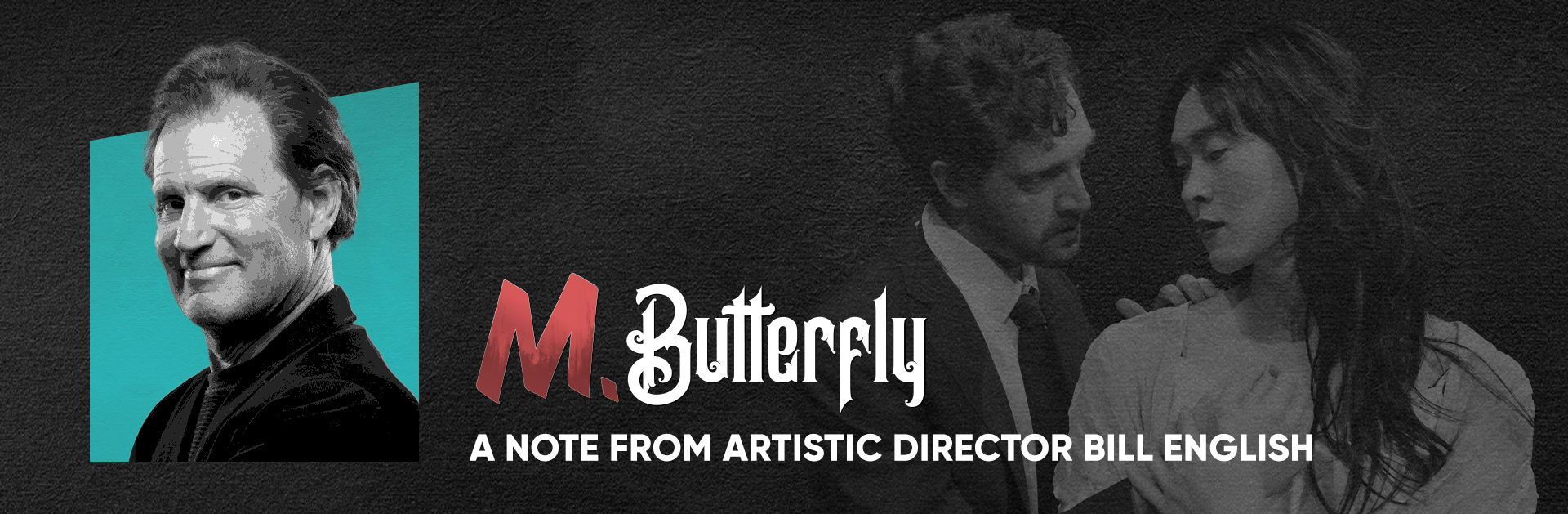
When M. Butterfly premiered in 1988, it detonated theatrical expectations. It asked Western audiences to confront how deeply our fantasies about the East distort what we are seeing. Nearly four decades later, far from feeling like a revival of an American classic, it feels more urgent.
Despite our infinite access to information, the West still struggles to understand China: politically, culturally, emotionally, and philosophically. China is invariably flattened into headline, ideology, and economic threat. What we miss is complexity: the lived contradictions, the ancient traditions evolving inside a hyper-modern world, the humanity behind the myth. In M. Butterfly, David Henry Hwang exposes how easily we project our desires, fears, and narratives onto another culture, and then mistake those projections for truth. Gallimard does not fall in love with a person, he falls in love with a story he desperately wants to believe.
That impulse has only intensified in the 21st century. We build simplistic narratives to protect ourselves from ambiguity. We select versions of reality that confirm what we already think we know. M. Butterfly reveals the danger of those delusions. Misunderstanding is not merely accidental, it is often willful. We misunderstand because true seeing would require surrendering power.
At the same time, this play now lives in a radically transformed conversation around gender. When M. Butterfly first appeared, its interrogation of gender performance was startling. Today, as gender fluidity, nonbinary identities, and self-definition have become part of our cultural consciousness, the play resonates in new and complicated ways. Song is not simply “a twist” to the plot. Song is a living challenge to the idea that gender is fixed, or owned by anyone’s perception. The character exposes how often gender, like culture, becomes assigned rather than something we discover.
In our current moment, gender is not a disguise to be unmasked, it is truth to be respected. This production approaches M. Butterfly through that lens. We are less interested in revelation than in recognition: the recognition of how often we insist on defining others instead of allowing them to define themselves.
At San Francisco Playhouse, our mission is to uplift the human spirit by deepening self-awareness and nurturing compassion. M. Butterfly serves that mission powerfully. It asks us to face that we are still seduced by illusion, that we substitute our own invented narrative for encounter, and that our fear of complexity keeps us from genuine connection. This play is not about East versus West, or male versus female. It is about the seductive trap of certainty. It is about the longing to be seen, and the terrible price we pay when we refuse to see.
San Francisco Playhouse
450 Post St.
San Francisco, CA 94102
(415) 677-9596
(c) 2024 San Francisco Playhouse
A 501(c)(3) nonprofit organization. Tax ID: 86-1089699
Privacy Policy | Accessibility